

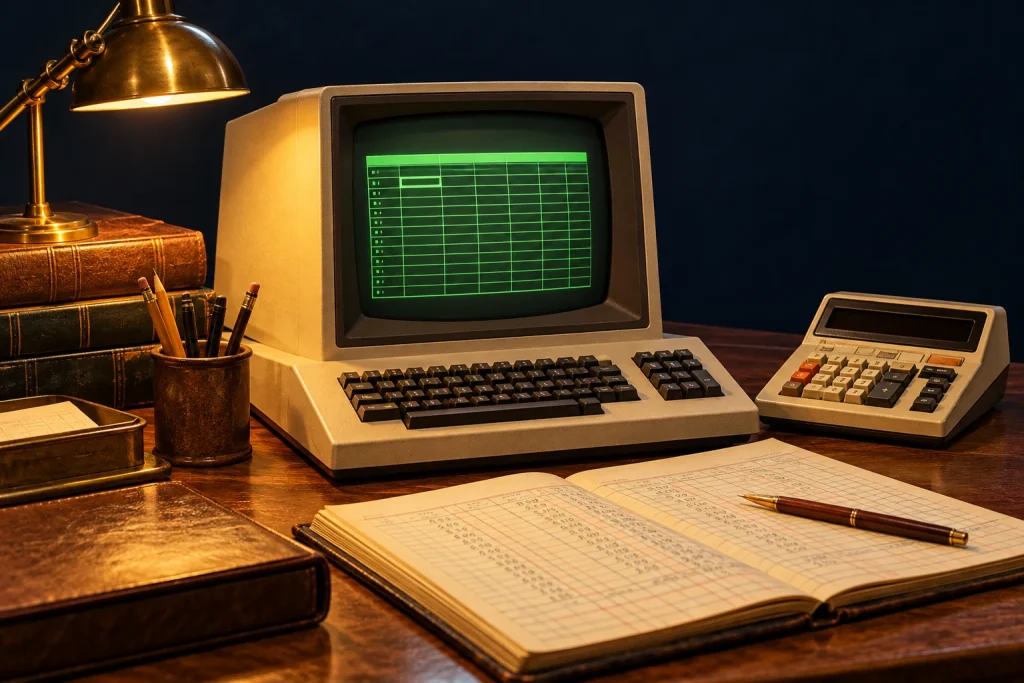
A grid becomes powerful when changing one number recalculates related results. Spreadsheets brought this ability to people who did not want to write complete programs.
Relationships instead of repeated arithmetic
Cells can hold data or formulas referring to other cells. Users define the relationships while the computer repeats calculations. Alternative quantities or assumptions can be tested without rebuilding the whole table.
VisiCalc’s example
Dan Bricklin and Bob Frankston’s VisiCalc, released for the Apple II in 1979, demonstrated how an application could provide a practical reason to buy a computer. Later products expanded the idea with charts, data handling and automation.
Clarity and correctness
A neat table can still contain a wrong reference or inconsistent units. Clear labels, documented assumptions and separation of inputs from calculations help others understand the result. Human checking remains essential.
Everyday programming
Defining relationships between cells is a form of computational thinking. The spreadsheet allowed a broad audience to build small personal tools. In a historical collection, its quiet screen of numbers explains a major change in office work.
Sources and further reading
The accompanying image was created with AI for PC.gr as an artistic illustration of this article’s subject.
Σύνταξη & Επιμέλεια: Βλαχογιάννης Λ. Γεώργιος
Μέλος της Ένωσης Συντακτών Εφημερίδων, Περιοδικών και Ηλεκτρονικών Μέσων Βορείου Ελλάδος