

Selling an unseen experience
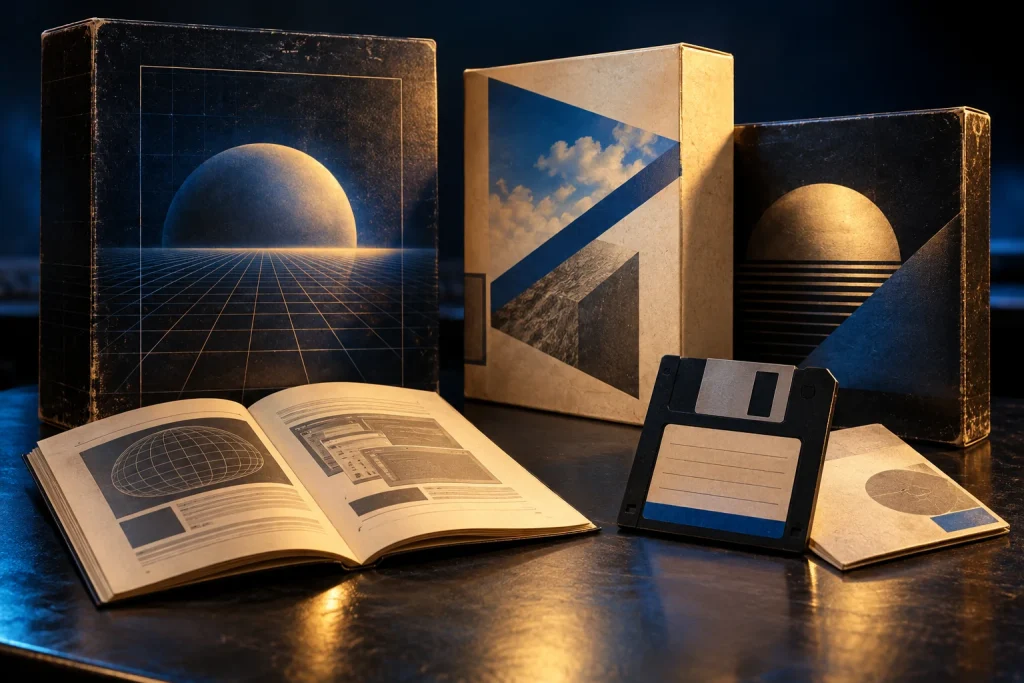
A software box protected media and gathered manuals, registration cards and other material. It also established a product’s identity before a customer saw it running.
Reading compatibility
Memory, operating-system and peripheral requirements mattered. Similar covers could conceal editions for different platforms. Artwork was not necessarily an in-game screenshot, so historical interpretation should distinguish illustration from actual output.
Local traces
Distributor stickers and translated inserts reveal routes into different markets. A Greek label does not prove that the entire application was localised. Original material and later additions should be recorded separately.
Keeping the set together
Boxes, disks and inserts form a connected record. Documenting their relationship preserves information even when the software cannot run. Packaging captures the moment before use: the expectations that a program would improve work, support creativity or provide entertainment.
Sources and further reading
- Computer History digital history collection — Selling the Computer Revolution: Software
- Computer History digital history collection — Collections
The accompanying image was created with AI for PC.gr as an artistic illustration of this article’s subject.
Σύνταξη & Επιμέλεια: Βλαχογιάννης Λ. Γεώργιος
Μέλος της Ένωσης Συντακτών Εφημερίδων, Περιοδικών και Ηλεκτρονικών Μέσων Βορείου Ελλάδος