

A spinning hard drive once supplied a familiar background sound. Its importance extended beyond mechanics: it let a computer retain an increasingly personal working environment.
Before the PC
IBM’s 305 RAMAC, introduced in 1956, was an important milestone in magnetic-disk storage. Smaller mechanisms and increasing capacity later brought this kind of storage into personal computers.
Inside the enclosure
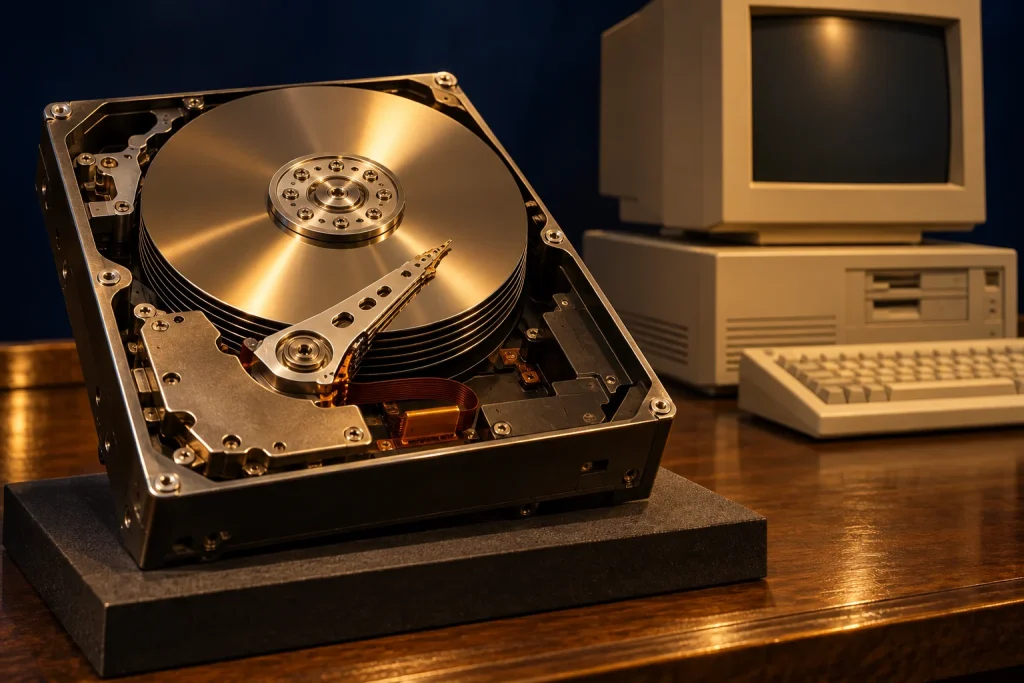
Rotating magnetic surfaces and moving heads work with a controller to read and write data. Capacity, access time and transfer speed describe different aspects of performance. An opened digital history collection drive is a demonstration object, not an example of safe maintenance for a working device.
A persistent workspace
Operating systems and applications could stay installed instead of requiring repeated disk swaps. Documents and settings accumulated in folders. That convenience increased the importance of independent backups: persistent did not mean indestructible.
Personal history
Directory structures can reveal working habits, but historical interest does not automatically make private files appropriate for publication. The drive’s broader story is continuity: each startup could return the user to the work and ideas left behind the previous day.
Sources and further reading
The accompanying image was created with AI for PC.gr as an artistic illustration of this article’s subject.
Σύνταξη & Επιμέλεια: Βλαχογιάννης Λ. Γεώργιος
Μέλος της Ένωσης Συντακτών Εφημερίδων, Περιοδικών και Ηλεκτρονικών Μέσων Βορείου Ελλάδος