

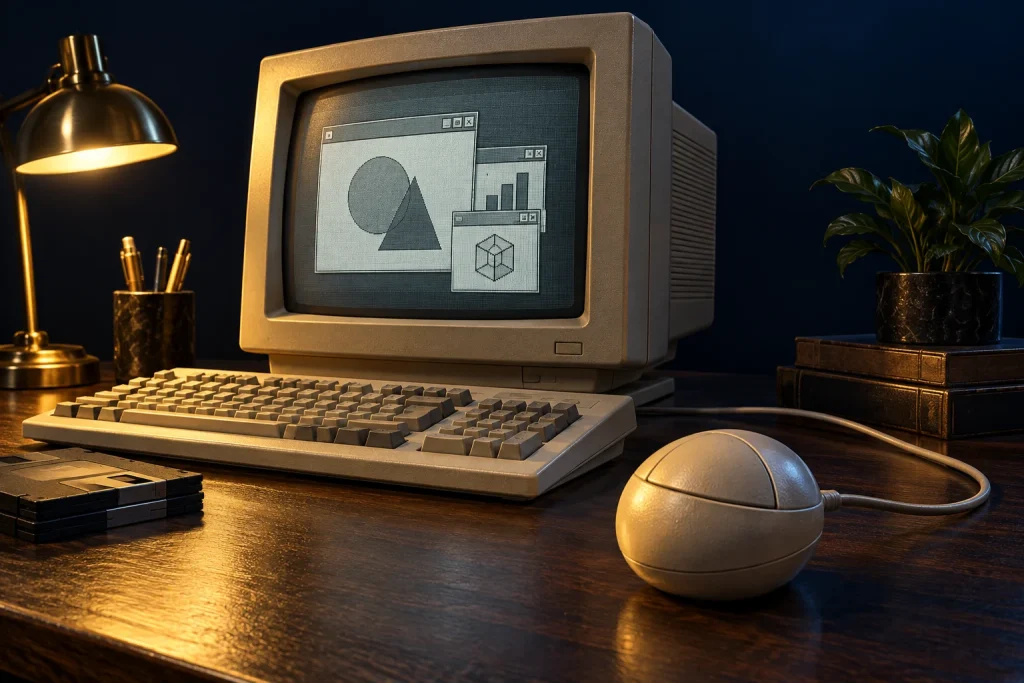
The mouse connected hand movement with a pointer on screen. Combined with windows, icons and menus, it helped make available actions visible rather than requiring users to remember every command.
Research before mass adoption
The Xerox Alto brought a graphical display, keyboard and mouse into a research environment that influenced later personal computers. It was not an ordinary home product, but an important setting for exploring new ways to work.
The Apple Lisa and Macintosh later contributed to the commercial development of these ideas. Introduced in 1984, the Macintosh helped bring graphical interaction to a broader audience. This was a sequence of contributions, not a single invention by one company.
The desktop metaphor
Documents, folders and a wastebasket gave intangible data familiar forms. Windows separated work areas, while menus exposed commands. Good interaction still depended on clear feedback, readable text and consistent behaviour; an icon without context could remain confusing.
Different tools, shared goals
Mouse mechanisms evolved from early mechanical designs to ball-based and optical devices. Keyboard shortcuts and other input methods offered alternatives. Command-line and graphical interfaces continued to coexist because they supported different tasks.
Reading an interface as history
The way a historic computer opened a file or edited a document reveals assumptions about its users. Its interface is as important to its story as the case, processor or screen. Even a small pointing device can illuminate a major change in design.
Sources and further reading
- Computer History digital history collection — Graphical User Interfaces
- Computer History digital history collection — Hello: The Mac at 40
The accompanying image was created with AI for PC.gr as an artistic illustration of this article’s subject.
Σύνταξη & Επιμέλεια: Βλαχογιάννης Λ. Γεώργιος
Μέλος της Ένωσης Συντακτών Εφημερίδων, Περιοδικών και Ηλεκτρονικών Μέσων Βορείου Ελλάδος