

Organising ideas
Niklaus Wirth designed Pascal in 1970. It became closely associated with teaching structured programming while also supporting practical development. Procedures and explicit data types encouraged programmers to divide larger tasks into understandable parts.
Feedback at the desk
Personal-computer development environments brought editing, compilation and execution together. Shorter feedback cycles made experiments easier. Compiler checks could expose certain mistakes, but they could not decide whether a program solved the right problem.
A small example
Sorting book titles requires choices about representation, comparison and empty input. The language supplies tools; the programmer still supplies an analysis of the task.
Reading an old program
Student source code preserves comments and habits of thought. The compiler version and execution instructions matter because implementations introduced different extensions. Pascal’s historical significance therefore extends beyond syntax: it shows how people learned to formulate assumptions, test them and revise their reasoning through a personal computer.
Sources and further reading
- ETH Zurich — Pascal: a programming language that conquered the world
- ETH Zurich — The programming language Pascal, 1970
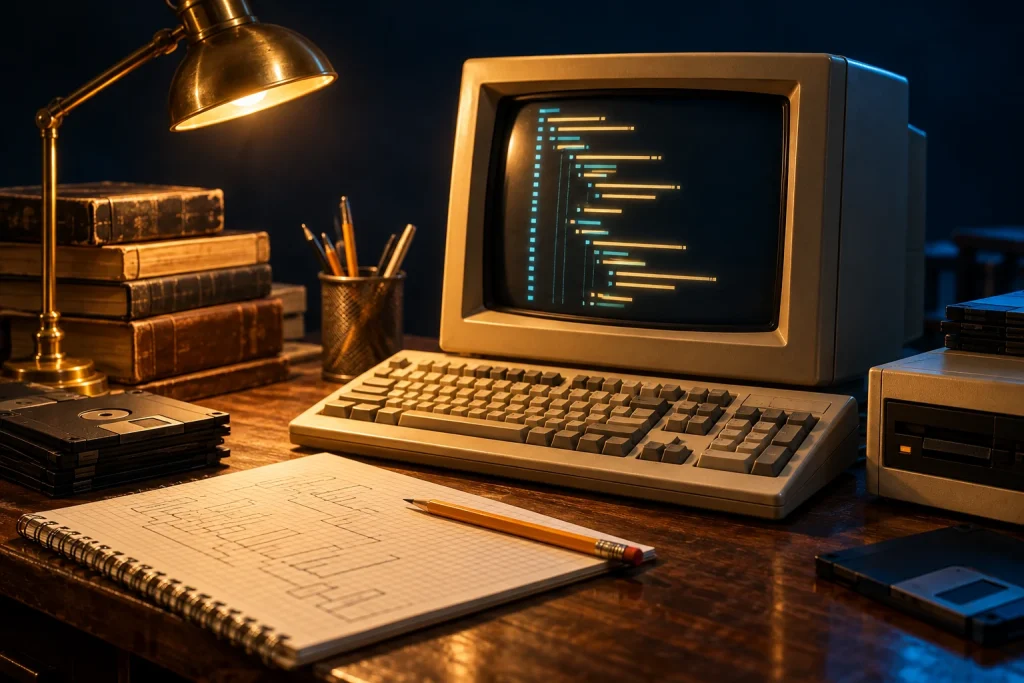
The accompanying image was created with AI for PC.gr as an artistic illustration of this article’s subject.
Σύνταξη & Επιμέλεια: Βλαχογιάννης Λ. Γεώργιος
Μέλος της Ένωσης Συντακτών Εφημερίδων, Περιοδικών και Ηλεκτρονικών Μέσων Βορείου Ελλάδος