

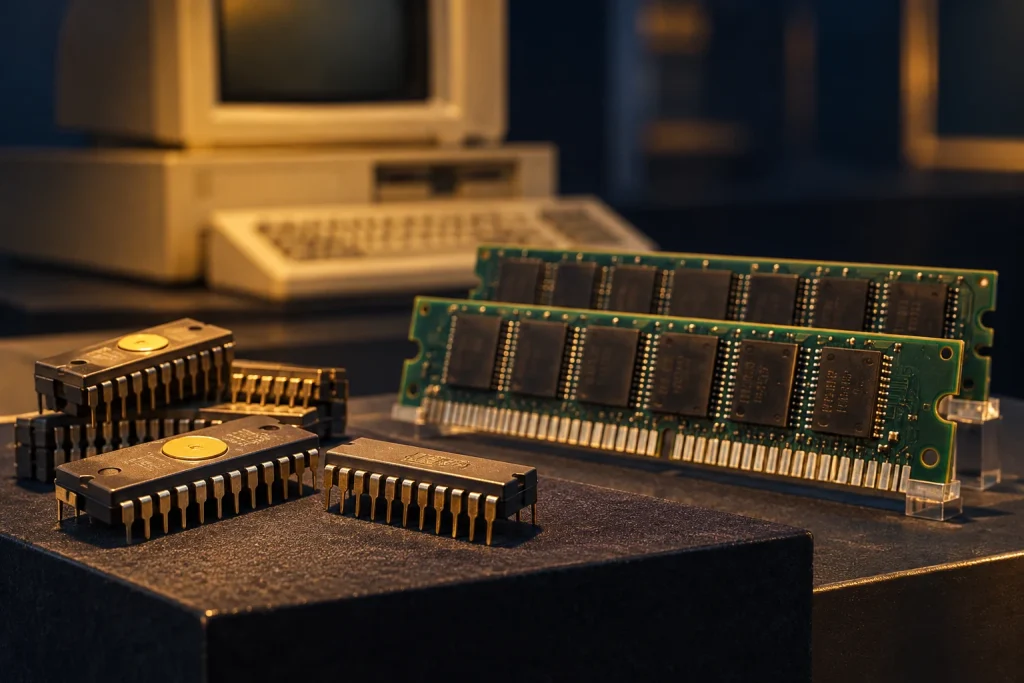
Old computer specifications often list memory beside the processor. Those small capacities determined whether a program would fit, how large a document could become and which features were usable.
Working memory and storage
Main memory holds instructions and active data. Ordinary RAM loses its contents when power is removed; disks and tapes keep saved files for later. A desk and a cupboard offer a useful analogy: working space and long-term storage serve different purposes.
Semiconductor memory
Integrated memory circuits gradually displaced magnetic-core designs. DRAM, associated with Robert Dennard’s work at IBM, periodically refreshes stored electrical charges. Devices such as Intel’s 1103 helped establish semiconductor main memory.
Designing within limits
Programmers economised through smaller graphics, reused data and loading material in stages. More physical memory did not automatically help every application: processors, motherboards and operating systems imposed their own limits on access.
Reading a surviving machine
A computer’s present configuration may include later upgrades. Documenting original and added memory avoids confusing the machine’s launch specification with its subsequent working life. RAM is therefore more than a technical number: it helps explain what users could actually accomplish.
Sources and further reading
- IBM — Dynamic random-access memory
- Computer History digital history collection — Semiconductors compete with magnetic cores
The accompanying image was created with AI for PC.gr as an artistic illustration of this article’s subject.
Σύνταξη & Επιμέλεια: Βλαχογιάννης Λ. Γεώργιος
Μέλος της Ένωσης Συντακτών Εφημερίδων, Περιοδικών και Ηλεκτρονικών Μέσων Βορείου Ελλάδος