

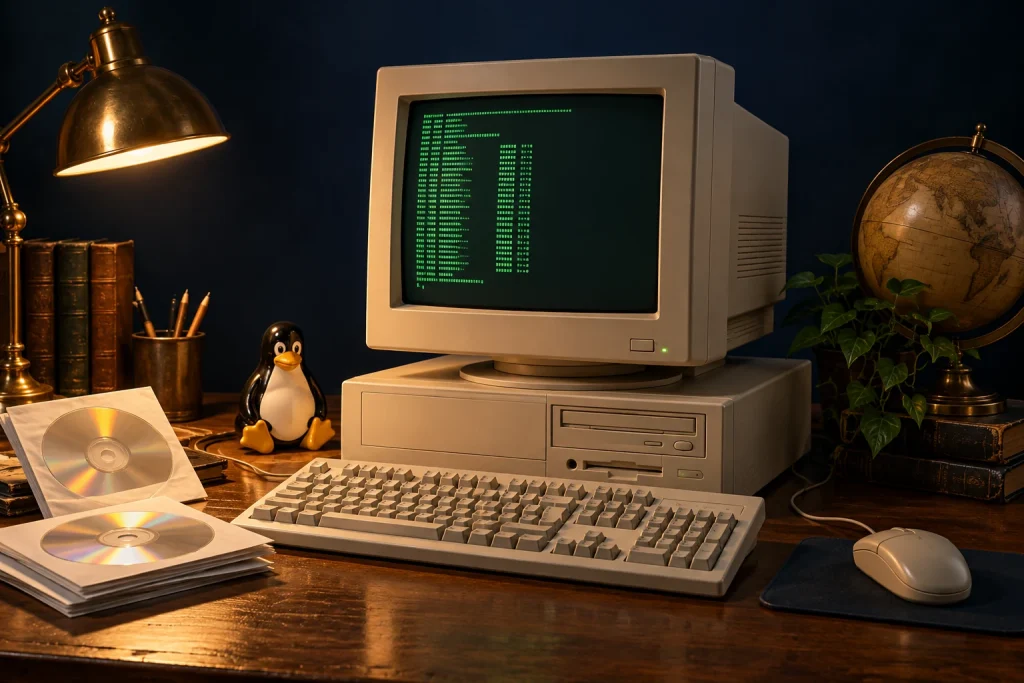
Personal-computer history includes people sharing code, reporting problems and improving tools across distances. Linux became an important example of this collaborative approach.
Kernel and complete system
Linus Torvalds released the Linux kernel in 1991. A kernel manages central resources, but an everyday system also needs libraries, utilities and applications. GNU tools and many other projects contributed components that distributions assembled into usable collections.
Reading and contributing
Source code can help programmers investigate behaviour. Licences determine the terms of use, modification and distribution; those terms are not identical for every project. Documentation, testing, translation and bug reports also constitute valuable contributions.
Learning through installation
Trying a distribution often encouraged users to understand disks, files and configuration. Difficulty varied by period and hardware. Manuals and support communities helped turn individual discoveries into shared knowledge.
Collective continuity
A collaborative project’s history extends beyond its first author. Coordination and continuing maintenance matter. An old Linux installation can therefore illustrate the PC as a point of participation in a wider technical community.
Sources and further reading
- Computer History digital history collection — 1991
- GNU Project — Linux and GNU
- Linux Kernel Archives — Historic releases
The accompanying image was created with AI for PC.gr as an artistic illustration of this article’s subject.
Σύνταξη & Επιμέλεια: Βλαχογιάννης Λ. Γεώργιος
Μέλος της Ένωσης Συντακτών Εφημερίδων, Περιοδικών και Ηλεκτρονικών Μέσων Βορείου Ελλάδος