

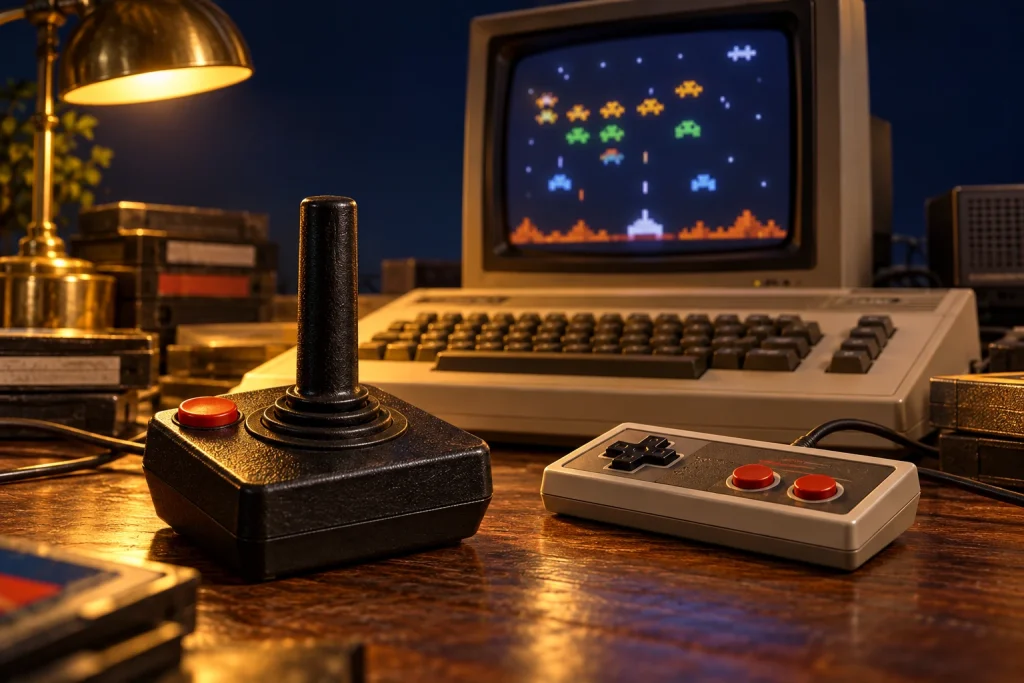
A game includes the movement that produces an action. Button placement, mechanical resistance and response can make the same software feel different on another system.
Turning movement into data
Digital joysticks report directions through switches. Analogue designs can describe a changing position. Reporting “right” differs from reporting how far a control has moved. More buttons do not automatically improve an interface; clear mappings matter.
Different platforms, different assumptions
Atari-associated controllers became recognisable gaming objects, and related forms appeared around home computers. Similar connectors alone do not establish electrical compatibility. Some games assumed a joystick, while others depended on keyboards or other devices.
Learned movements
Repeated play builds physical habits, explaining why an old controller can carry strong memories. Different hands and movement abilities also require different solutions.
Preserving the interaction
A modern replacement may make demonstration practical while changing part of the experience. Recording that difference helps visitors understand the original design. A controller belongs beside the machine and software as evidence of how people actually played.
Sources and further reading
- Computer History digital history collection — Joystick for gaming applications
- Computer History digital history collection — Input & Output
The accompanying image was created with AI for PC.gr as an artistic illustration of this article’s subject.
Σύνταξη & Επιμέλεια: Βλαχογιάννης Λ. Γεώργιος
Μέλος της Ένωσης Συντακτών Εφημερίδων, Περιοδικών και Ηλεκτρονικών Μέσων Βορείου Ελλάδος