

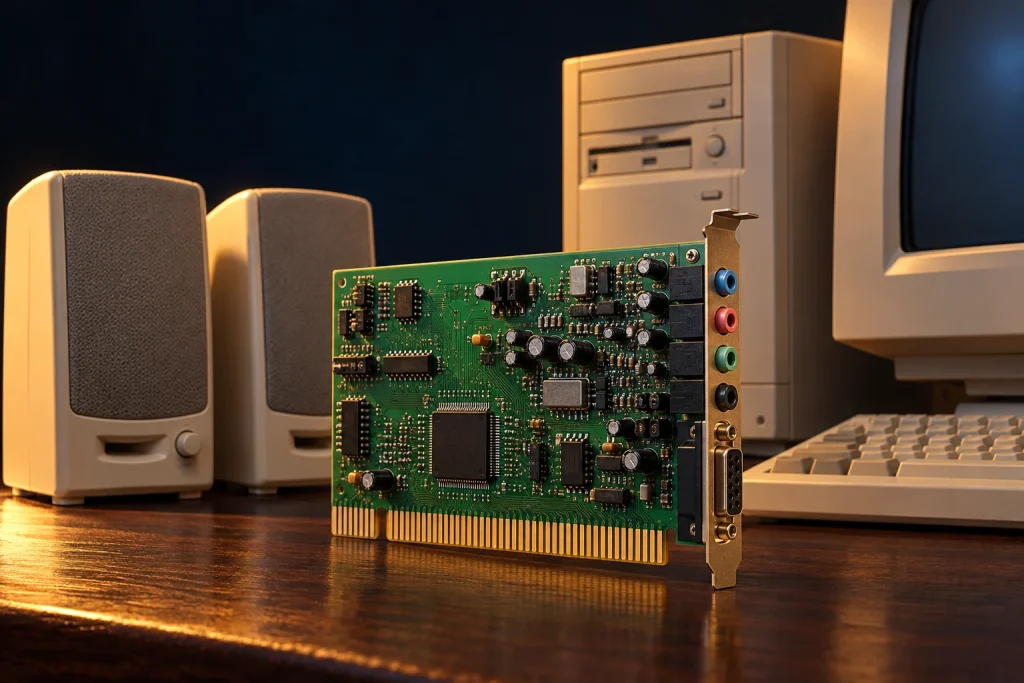
An early PC might announce itself with a beep or a simple melody. Later machines brought music, speech and layered effects to the same desk. Sound changed what people expected a computer to do.
Different starting points
The internal speaker in early IBM PCs and many compatibles served basic needs. Creative programming could extend its use, but rich audio remained difficult. Other computer families had different, sometimes more specialised, sound hardware.
Expansion cards and software support
AdLib became associated with FM music in PC games. Creative introduced the first Sound Blaster in 1989, an important commercial development. Hardware capabilities mattered only when applications could use them, making support and configuration part of the experience.
Synthesis and recorded sound
Synthesis creates sound from instructions and parameters. Sampled audio reproduces a recorded waveform. Both approaches could contribute music, voices and effects. Memory and storage limits encouraged economical, inventive use of audio data.
A multimedia experience
Educational software could pronounce words, games could provide audible clues, and presentations could combine pictures with narration. Speakers and headphones became familiar desktop companions.
Preserving what people heard
A historic application’s sound is part of its identity. Different cards and settings can produce different results, so documenting the playback environment matters. A sound card represents more than circuitry: it records a change in the way people experienced their computers.
Sources and further reading
The accompanying image was created with AI for PC.gr as an artistic illustration of this article’s subject.
Σύνταξη & Επιμέλεια: Βλαχογιάννης Λ. Γεώργιος
Μέλος της Ένωσης Συντακτών Εφημερίδων, Περιοδικών και Ηλεκτρονικών Μέσων Βορείου Ελλάδος