

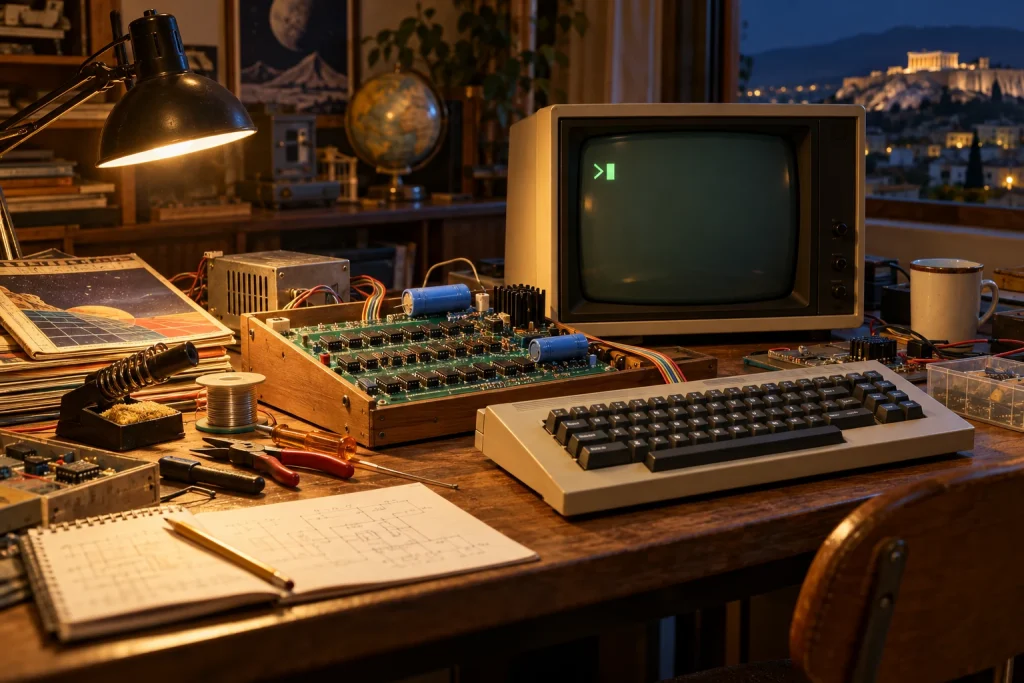
Personal computing gave individuals direct access to a machine for their own work. Its development involved technical advances, communities and competing business ideas, rather than a single inventor or product.
What made a computer personal?
Size alone was not enough. A personal computer also needed to be affordable to its intended users, useful and manageable outside a specialist computing centre. Different definitions explain why there is no simple, universally useful answer to the question of the “first PC”.
The Altair and the hobbyists
The Intel 8080-based MITS Altair 8800 appeared in the January 1975 issue of Popular Electronics. Its basic configuration used switches and indicator lights rather than the screen and keyboard familiar today. Sold as a kit, it attracted enthusiasts who wanted to build, expand and program their own machines.
Clubs and magazines became places to exchange ideas, solve problems and discover applications.
The ready-to-use computers of 1977
The Apple II, Commodore PET and TRS-80 brought more complete systems to market in 1977. Their different approaches to displays, storage and expansion offered users alternatives. Programming, educational software and games helped computers enter homes. Word processing and spreadsheets gave office users practical reasons to buy them.
The IBM PC in 1981
IBM introduced the Personal Computer, model 5150, in August 1981. IBM’s presence strengthened business confidence in personal computing. Compatible systems, peripherals and applications subsequently helped build a large market.
Other platforms continued alongside it, serving students, professionals, artists and players in different ways.
A lasting change
The achievement was the ability to write, calculate, learn and create on a machine of one’s own. PC.gr’s collection places these computers in the context of their time, showing why their different designs and capabilities mattered.
Sources and further reading
- Computer History digital history collection — Personal Computers
- Computer History digital history collection — 1975
- IBM — The IBM PC
The accompanying image was created with AI for PC.gr as an artistic illustration of this article’s subject.
Σύνταξη & Επιμέλεια: Βλαχογιάννης Λ. Γεώργιος
Μέλος της Ένωσης Συντακτών Εφημερίδων, Περιοδικών και Ηλεκτρονικών Μέσων Βορείου Ελλάδος