

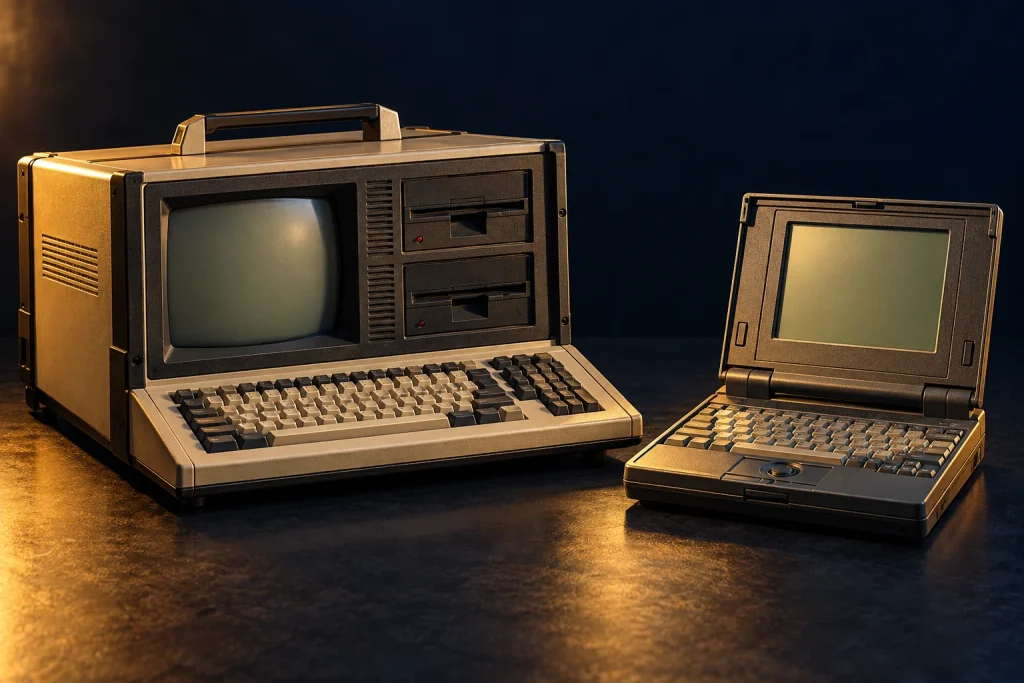
Closing a computer and carrying it away now seems ordinary. Early personal computers made this a design challenge: display, keyboard, storage and power had to fit into a practical travelling system.
Transportable, not necessarily lightweight
Early luggables often resembled carrying cases. A handle and detachable keyboard brought essential parts together, but users still needed a desk and often mains electricity. The Osborne 1, released in 1981, is a familiar example, combining a small display and floppy drives in one transportable package.
A different display, a different shape
Flat displays allowed proportions that were difficult with a cathode-ray tube. A hinged lid could open for work and close over the keyboard. Readability still depended on contrast, viewing angle, resolution and lighting; smaller did not automatically mean easier to use.
Power and durability
Battery operation introduced trade-offs between performance, operating time and weight. Heat, storage mechanisms and display consumption all mattered. Hinges, connectors and keyboards also had to withstand movement and repeated use.
Computing in new places
A computer could accompany its owner to a meeting, lesson or job away from the office. Comparing transportable and laptop machines reveals how many smaller improvements combined to make this possible. Portability was a property of the complete design, not simply a lighter case.
Sources and further reading
- Computer History digital history collection — Mobile Computing
- Centre for Computing History — Osborne 1
The accompanying image was created with AI for PC.gr as an artistic illustration of this article’s subject.
Σύνταξη & Επιμέλεια: Βλαχογιάννης Λ. Γεώργιος
Μέλος της Ένωσης Συντακτών Εφημερίδων, Περιοδικών και Ηλεκτρονικών Μέσων Βορείου Ελλάδος