

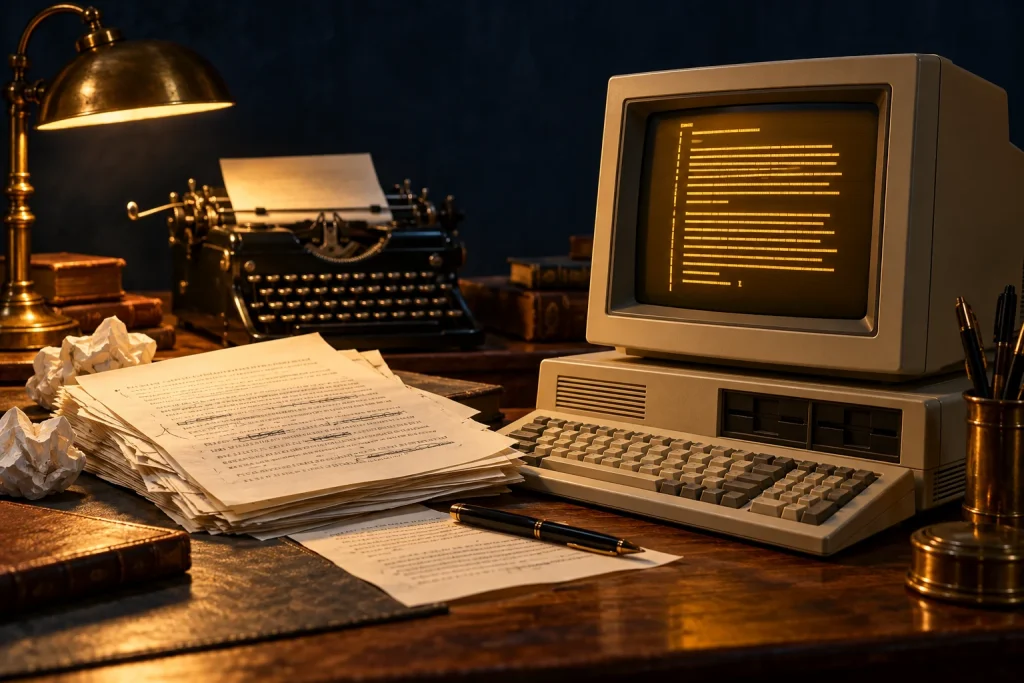
The word processor’s key contribution was the ability to return to text. A paragraph could move and a sentence could change without retyping the entire document.
Writing before printing
A computer separated composition from the permanent mark on paper. Drafts could be saved, revised and reused. Searching, copying and replacing made routine documents easier to adapt.
Early personal-computer applications
WordStar became associated with word processing on microcomputers. Commands and keyboard combinations required learning, and the screen did not always reproduce the printed page. Later graphical interfaces improved preview and exposed more options visually.
Language and compatibility
Greek typing required more than labelled keys. Input, character encoding, display and printing had to agree. File formats and fonts affected whether another computer could reproduce a document correctly.
Human editing
Convenient revision did not automatically improve meaning or accuracy. Writers still needed to check coherence and the effects of broad replacements. Historic word processors show how the PC became a workspace for thought, where a first version no longer had to be the final one.
Sources and further reading
The accompanying image was created with AI for PC.gr as an artistic illustration of this article’s subject.
Σύνταξη & Επιμέλεια: Βλαχογιάννης Λ. Γεώργιος
Μέλος της Ένωσης Συντακτών Εφημερίδων, Περιοδικών και Ηλεκτρονικών Μέσων Βορείου Ελλάδος