

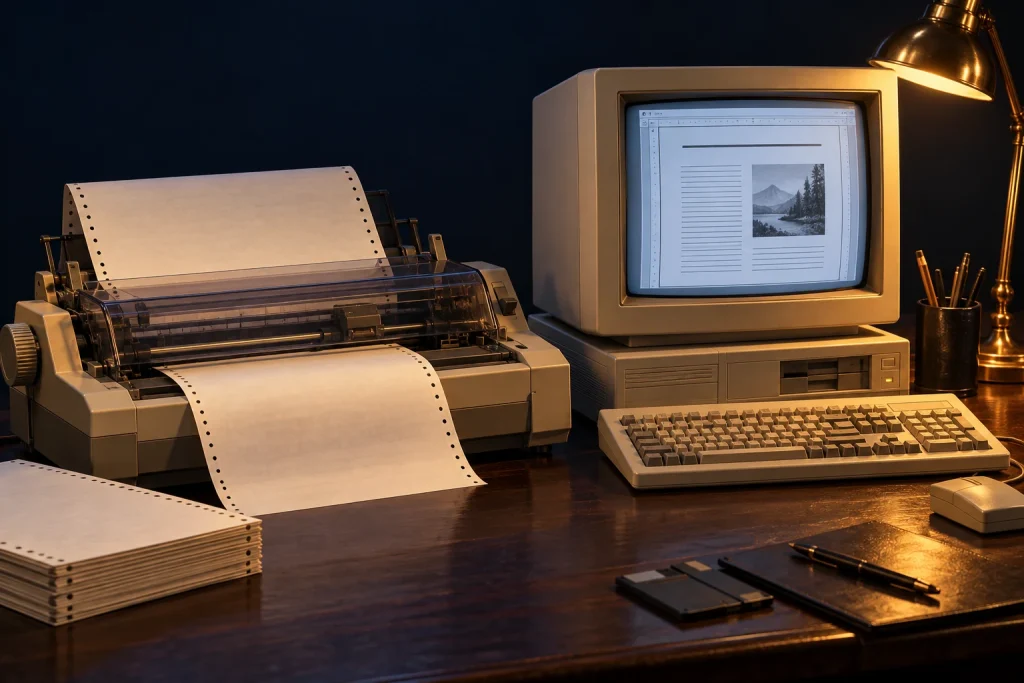
A letter, assignment or newsletter often needed to leave the screen. Printers turned digital work into something people could read, sign and share, expanding the practical value of the personal computer.
Printing with dots
Dot-matrix printers struck an ink ribbon with small pins to form text and graphics. Their sound and continuous perforated paper became familiar features of computerised offices. Reliability, consumable costs and supported forms mattered alongside speed and quality.
Designing the complete page
Page-layout software went beyond text editing by arranging words, images and empty space as a composition. During the 1980s, the Macintosh, LaserWriter and software such as PageMaker contributed to desktop publishing. Adobe’s PostScript helped describe pages for printing.
Preview and output
A closer relationship between screen preview and printed output gave users more control. Fonts, margins, resolution and printer capabilities still affected results, making a proof print useful. Changes could be incorporated without rebuilding an entire document.
Design remained a human task
More formatting options did not automatically create clearer pages. Readability, hierarchy and consistency still required judgement. The computer expanded access to publishing tools, while good communication depended on careful choices.
The page as evidence
A surviving printout beside its computer shows what users actually produced. It links hardware and software with the documents that circulated in everyday life.
Sources and further reading
- Computer History digital history collection — Laser Printers
- Computer History digital history collection — PostScript: A Digital Printing Press
The accompanying image was created with AI for PC.gr as an artistic illustration of this article’s subject.
Σύνταξη & Επιμέλεια: Βλαχογιάννης Λ. Γεώργιος
Μέλος της Ένωσης Συντακτών Εφημερίδων, Περιοδικών και Ηλεκτρονικών Μέσων Βορείου Ελλάδος