

More than 3D graphics
Virtual reality combines display, tracking and timely response to movement. Sound and controls can support the sense of presence. A three-dimensional picture alone does not provide the complete experience.
Research roots
Ivan Sutherland’s early head-mounted display, preserved by the Computer History digital history collection, records the difficulty of combining visual output and position tracking. Its importance lies in the experiment rather than resemblance to a modern product.
The personal-computer connection
Improved graphics supported more exploration, while cost, weight and response time remained constraints. Body movement also required different interface decisions from desktop pointing.
Purpose before spectacle
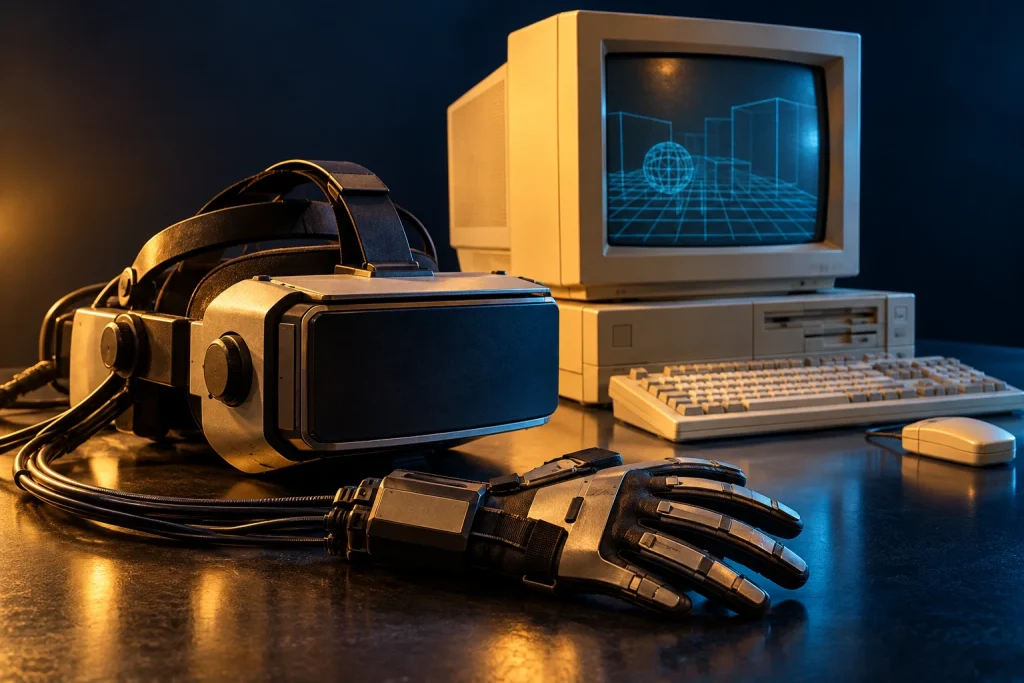
Training, simulation and spatial presentation have different needs. A useful virtual environment must serve its task, not merely impress. Historical headsets and gloves document the recurring ambition to make the computer a space for participation rather than only an image viewed from outside.
Sources and further reading
- Computer History digital history collection — Sutherland head-mounted display
- Computer History digital history collection — The Remarkable Ivan Sutherland
The accompanying image was created with AI for PC.gr as an artistic illustration of this article’s subject.
Σύνταξη & Επιμέλεια: Βλαχογιάννης Λ. Γεώργιος
Μέλος της Ένωσης Συντακτών Εφημερίδων, Περιοδικών και Ηλεκτρονικών Μέσων Βορείου Ελλάδος