

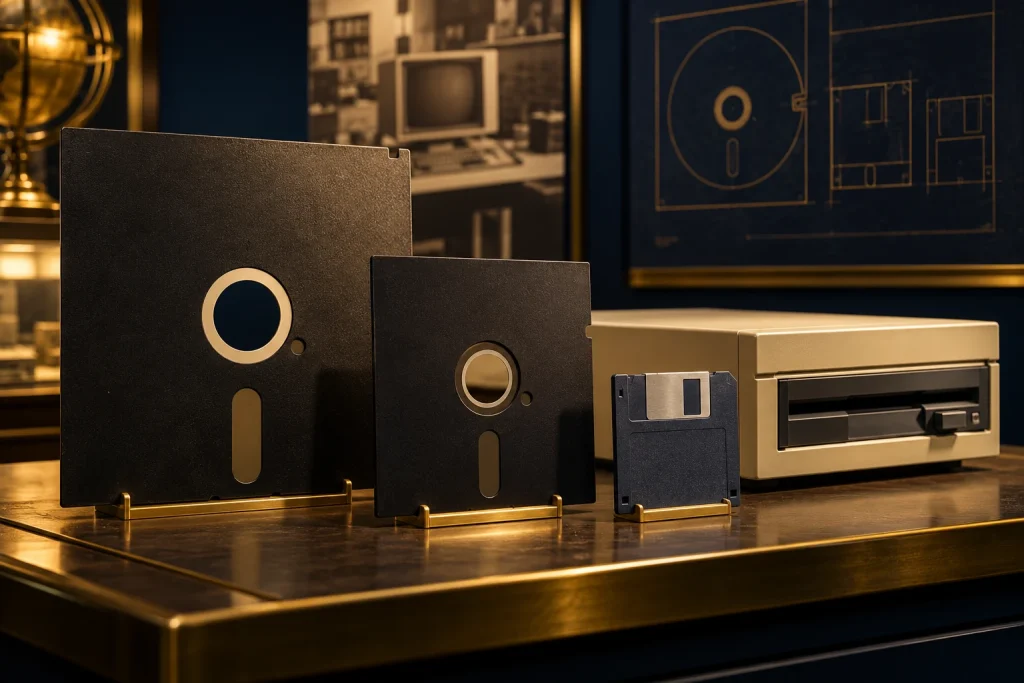
A handwritten label and the sound of a drive were once familiar parts of using a computer. Floppy disks carried text, programs and games between machines. Before fast networks were commonplace, they offered a practical way to move information.
How they worked
A flexible disk with a magnetic coating rotated inside its protective enclosure. A drive’s read/write head accessed data organised into tracks and sectors, while the operating system used a file structure to locate documents and programs.
The removable disk and its drive were separate components. Physical size alone did not guarantee compatibility: recording density and formatting also mattered.
Three familiar sizes
IBM introduced its 8-inch floppy disk in 1971, initially to load data into large systems. Smaller 5.25-inch disks later became closely associated with personal computers.
The 3.5-inch format used a rigid plastic case and a protective shutter, making it easier to carry. The magnetic disk inside remained flexible. Capacities and recording formats varied across generations and computer platforms.
Everyday use
Operating systems and applications were distributed on floppy disks. Users saved schoolwork, exchanged files and installed software by inserting several disks in sequence. Limited capacity encouraged careful labelling, organisation and backup copies.
Disks could also spread malicious software. Knowing where a disk came from and keeping independent backups were already important habits.
Preserving the contents
Larger files, other storage media and networks gradually displaced the floppy. Surviving disks may nevertheless hold unique personal or professional records. Reading them requires a compatible drive and careful handling. A disk that looks intact may not be readable; valuable originals should be protected from accidental writes.
At PC.gr, floppy disks represent both a storage technology and the experiences of the people who used it.
Sources and further reading
- Computer History digital history collection — Floppy Disks
- Computer History digital history collection — The Storage Engine
- Computer History digital history collection — Memory & Storage
The accompanying image was created with AI for PC.gr as an artistic illustration of this article’s subject.
Σύνταξη & Επιμέλεια: Βλαχογιάννης Λ. Γεώργιος
Μέλος της Ένωσης Συντακτών Εφημερίδων, Περιοδικών και Ηλεκτρονικών Μέσων Βορείου Ελλάδος