

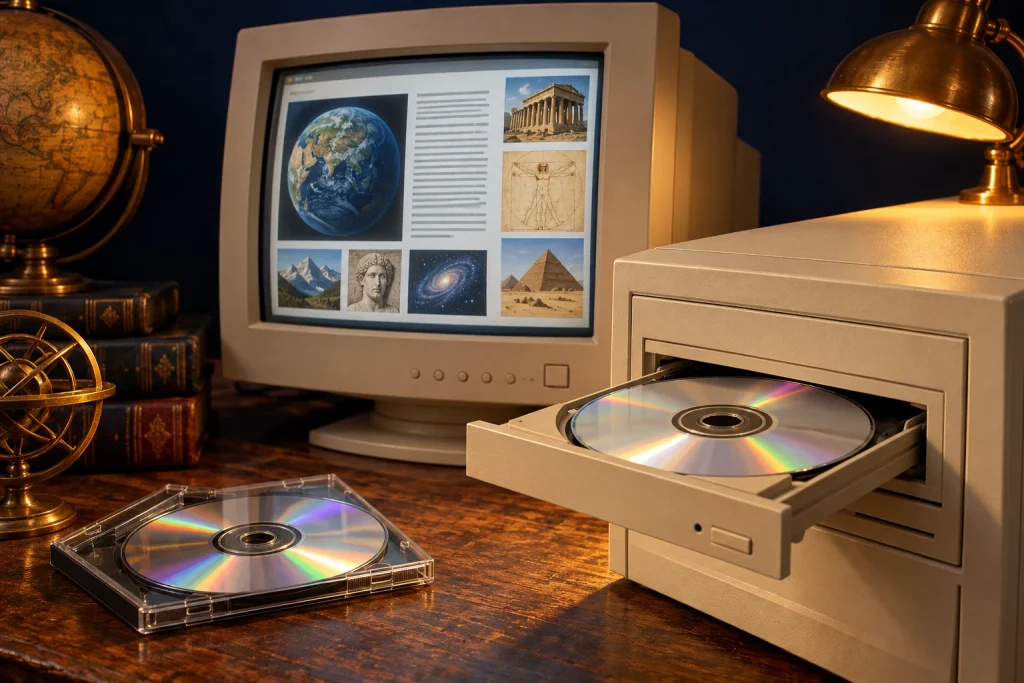
For many 1990s users, a silver disc opened a world of searchable information, pictures and sound without a continuous network connection.
Optical storage for computers
Compact-disc technology expanded from digital audio to computer data. CD-ROM offered a read-only distribution medium for material that would otherwise require many floppy disks. Similar-looking audio and data discs did not imply universal device or software compatibility.
Exploring information
Search tools and links connected entries, maps, photographs and recordings. Readers could follow their own routes through a subject. Capacity alone did not guarantee accuracy: editorial work and source quality still mattered.
The multimedia system
Games and educational applications used extra storage for richer graphics, music and video. A suitable drive, memory and sound hardware formed part of the experience. Mechanical access delays also influenced application design.
A preserved edition
A disc retains a particular release rather than continuously changing information. That limitation now has historical value. Together with manuals and system requirements, it records how digital knowledge was organised and presented at a specific time.
Sources and further reading
- Computer History digital history collection — Digital compact disc
- Computer History digital history collection — Consumer CD-R drives
The accompanying image was created with AI for PC.gr as an artistic illustration of this article’s subject.
Σύνταξη & Επιμέλεια: Βλαχογιάννης Λ. Γεώργιος
Μέλος της Ένωσης Συντακτών Εφημερίδων, Περιοδικών και Ηλεκτρονικών Μέσων Βορείου Ελλάδος