

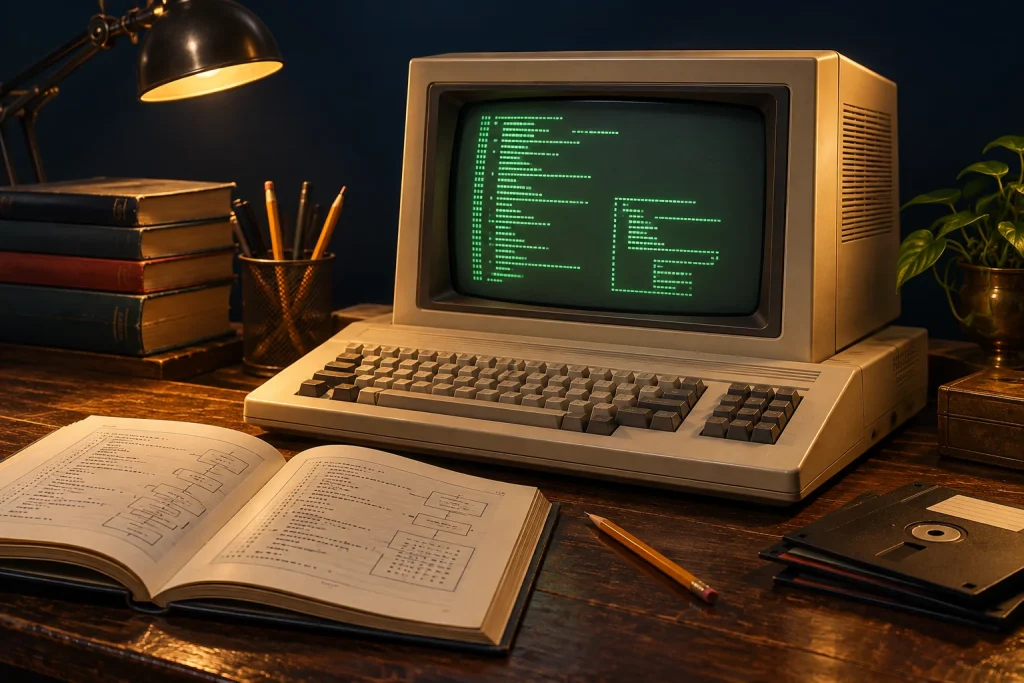
For many people, programming began with a computer waiting for a command. A few words and a press of Enter could produce a message or calculation. BASIC became associated with this direct, personal way of learning.
An educational beginning
John Kemeny and Thomas Kurtz developed BASIC at Dartmouth with student participation. The first programs ran on 1 May 1964. The aim was to make programming accessible beyond computing specialists. The language grew alongside Dartmouth’s time-sharing system, which allowed multiple people to work through terminals.
Immediate feedback
Many later microcomputers used a BASIC interpreter. Users could try commands and see results quickly; several home computers offered this environment immediately after switching on. Variables, conditions and loops became easier to understand through small experiments.
Learning from printed programs
Manuals and magazines supplied listings to type in. Correcting mistakes required attention to symbols and instruction order. Changing a message, colour or option then turned copying into experimentation. Even a modest program could make the computer feel like a creative tool.
One name, many dialects
BASIC did not mean universal compatibility. Commands for graphics, sound, files and memory varied between implementations. Moving a program to another machine could require adaptation, which explains why printed listings identified their intended computer so carefully.
A lasting habit
BASIC’s legacy includes a practical approach: try something, observe the result and revise it. Historic keyboards and screens recall a time when the invitation to program was part of everyday computer use.
Sources and further reading
The accompanying image was created with AI for PC.gr as an artistic illustration of this article’s subject.
Σύνταξη & Επιμέλεια: Βλαχογιάννης Λ. Γεώργιος
Μέλος της Ένωσης Συντακτών Εφημερίδων, Περιοδικών και Ηλεκτρονικών Μέσων Βορείου Ελλάδος