
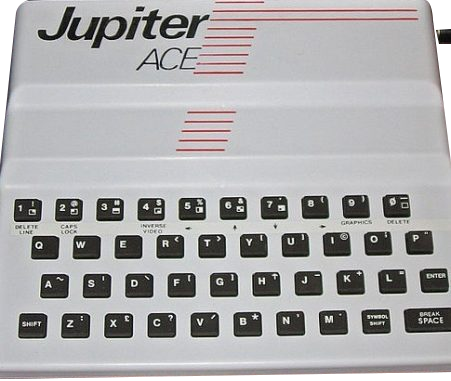
Jupiter Ace (by Jupiter Cantab)
Year of manufacture: 1983
Technical Specifications:
- Processor: Zilog Z80A , 3.25 MHz
- RAM: 3 KB
- FDD: –
- HDD: –
- Audio: Beeper
- Connectors/Ports: User, cassette tape, processor bus, TV
- Case: Keyboard type
- Monitor: Monochrome
- OS: ACE Forth
The Jupiter Ace has a Zilog Z80A processor and 3 KB of RAM. Its Forth programming language is built into ROM.
The British home computer manufacturer released the Jupiter Ace in 1982. Its architecture resembled the ZX81 and ZX Spectrum, but the strongest point of the computer was the choice of chosen language, the structured Forth vocabulary. Forth programs were more efficient, especially on reusing previously defined code when the size increased. Considered ten times faster and less memory dependent than other competitors, another strong feature was the easy and fast decompiling.
Jupiter Cantab Limited was founded by two ex Sinclair research staffers, Richard Altwasser and Steven Vickers. The Jupiter Ace wasn’t very popular, possibly because of accessibility of the Forth language. The company went bankrupt in 1983 and sold the assets to Boldfield Computing Ltd the year after.
Continue reading more about the present model, the Jupiter Ace here.
PC.GR
The history of personal computers
Explore this digital exhibit with the video guide, which opens the PC.gr presentation in a video window. Source series: TechMuseum.